Lens Filters - How Can They Elevate Your Photography?
Lens filters have more than the simple concept of protecting your highly engineered camera lens glass. Depending on what type/kind of filter you use can have dramatic effects on your images/footage.
Let’s go through the basic features of the most common types of filters & how they can be applied to your next captures:
UV filters are completely transparent glass filters that block Ultra-Violet rays from hitting your camera’s imaging sensor when you capture a photograph or footage. Ultra-Violet rays can cause things like unwanted haze and slight blue-cast. While most modern cameras are quite sophisticated at auto corrections - having the lens filter assists your camera in more accurate corrections again. UV Filters are often referred to as “Protective Filters” as well. This is because of the fact they are physically screwed/attached to the outer element of your lens, they naturally protect your len’s actual front glass element. So, when you’re out in the field and a piece of gravel hits the lens, sharp thorns graze across it or just have accidental scrapes with your camera, you are scratching and damaging a replaceable glass filter instead of your nice lens!
Often referred to as a Circ-Pol or CPL filter, this is where things start to get interesting when it comes to imagery changes via a filter.
When a CPL is rotated, it is able to break through angles of light to cut down on reflections, allowing you to photograph without them. This typically works for photographing water and glass surfaces. Some may refer to this process as “mattifying surfaces”. In addition to cutting down reflections, when a CPL is rotated, it creates more contrasting colour values often resulting in more polished photographs or footage. This makes the CPL filter a popular choice for real estate photographers as well as automotive photographers, who are constantly fighting reflections on surfaces.
Neutral Density & Their Variations
Neutral Density Filters, or ND for short, are used when your goal is to shoot with settings and/or conditions that would otherwise typically over expose your image/scene. As an example, if you were wanting to photograph a river scene where you wanted the water to appear like silk, this would require a slower than normal shutter speed. However, if you keep your shutter speed open too long, the result is an over exposed image. That leaves you very limited for landscape options! However, when we attach a ND filter we need the camera to have a longer shutter speed to cut through the darkness of the filter. There are different densities you can choose from ND2 being lighter/less intense and going up to ND1000. The darker the filter, the longer you are able to keep your shutter speed open for.
You can even get Variable ND Filters, which combine the rotational concept of a CPL Filter - well suited for videographers who are constantly changing environments and/or scenes on the same shoot.
Another variation of the ND comes in the form of the Graduated Neutral Density - as the name implies, it is a static stop of density however - it is graduated meaning it is stonger at one end than the other. Typically used for people who want to have a longer exposure on a sky and/or foreground without affecting the other. In the below example, we can see that if we expose for the foreground, the sunset is lost. With a graduated ND on the sky, we are able to bring down the exposure of the sky, while maintaining our foreground is adequately exposed for. If we did this with a standard ND, you’ll notice that since it is the same density across the entire image, it results in a darker exposure in those areas we wanted more flexibility.
You wont typically find Graduated ND filters in a circular screw-in lens format. These are usually sold in the form of sheets where a specific holder would be attached to the front of your lens. This is so you can use the same sheets across multiple different lenses without needing to repurchase, unlike standard screw-in filters which are limited to the specific dimensions of a lens.
Filters are a great way to protect your gear, no matter what you choose. You’ll notice that the more specialised, they tend to increase in price value. So, if your goal is to simply protect your lens, then the UV filter is the best range for you. If you’d like some protection, but also som extra light control in your images, you should try a CPL filter - especially if you like photographing cars, rock pools or real estate! If you’re feeling more advanced and dedicated to landscapes, Standard NDs are a great addition to your kit. But if you need more vairety or are a videographer, a Variable ND will most likely be your new best friend.
“But can’t I just edit this all in post?” - Technically, yes, you could. But constantly having to edit, and enhance these “imperfections” in or out of your images is time consuming and in some cases, not able to be sustained. “Work smarter, not harder!” Is more the mentality you should be using. If a piece of equipment can help achieve what I see in my mind’s eye for how I would like to capture the scene in camera, whilist also protecting my gear, rather than spend potentially hours tweaking each element slider - it sounds like a better idea to me!
What Does Diamonds Camera Recommend For Me?
We have created filter starter kits - just for you!
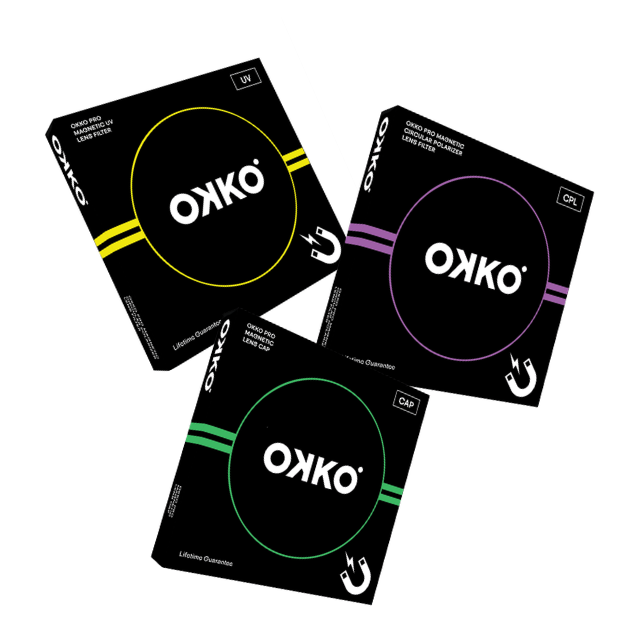
We know purchasing filters can be overwhelming with the amount of variety on offer. That’s why we’ve created the OKKO Magnetic Filter Starter Kits. These kits give you a UV and a CPL to start with. And the coolest part? They’re magnetic! Meaning with the UV filter screwed in, it acts as a magnetic anchor for the CPL. Simply attach and detach it when you feel like it - no need to remove the previous filter and waste time and maintain full rotational control. With these starter kits that also include the magnetic lens cap, you fumble less, capture more and can easily expand your filter kit.
Click the filters to find your size!
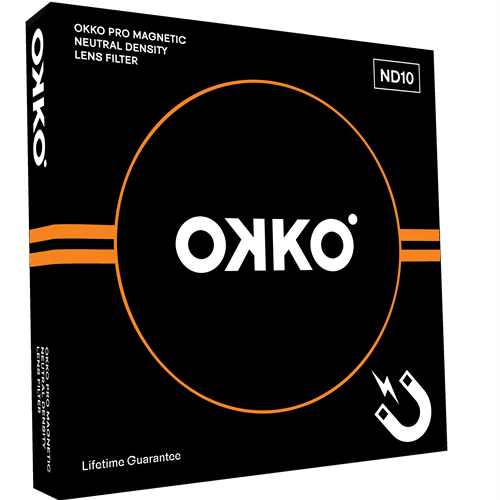
OKKO also make a series of magnetic standard ND filters, which also magnetically attach straight away - How convenient!
|
|
What’s even cooler? All OKKO Pro Magnetic Series filters have a lifetime warranty! “You Break It? We Replace It!”
Just bring it back to Diamonds Camera, and we will replace it for you on the spot or order in the replacement you need.
Shop the Full Range with Diamonds Camera Today!